
1-Inch vs 1.25-Inch Handlebars Wholesale Supplier
Diameter is not just an aesthetic choice; it is a mechanical constraint that dictates control compatibility and wiring capacity.
Choosing between 1-inch and 1.25-inch handlebars requires verifying the clamp zone diameter, internal wiring hole size, and control switch housing dimensions against the specific motorcycle model. For Harley-Davidson Big Twins and Yamaha XS650 builds, mixing these diameters without checking the control clamp area results in incompatible switches, failed cable routing, and costly returns. A 1.25-inch bar often needs specific controls or shims, while a 1-inch bar may lack the internal space for modern thick-wire harnesses.
I still remember the silence in the Qingdao workshop when a container of 1.25-inch bars arrived back from North America. The customer had ordered them for a batch of custom Softail builds, assuming they were direct replacements for the stock 1-inch units. They were not. The throttle cables could not pass through the internal wiring holes, which were machined to a budget-spec diameter rather than the generous clearance needed for aftermarket harnesses. Worse, the control clamps slipped because the flat section on the bar did not match the width of the standard Harley-style switches. That return taught me that outer diameter is only the starting point. The real fitment issues hide in the clamp zone machining and the internal bore. [NEED_CITE: common causes of handlebar fitment failure in aftermarket V-twin parts]
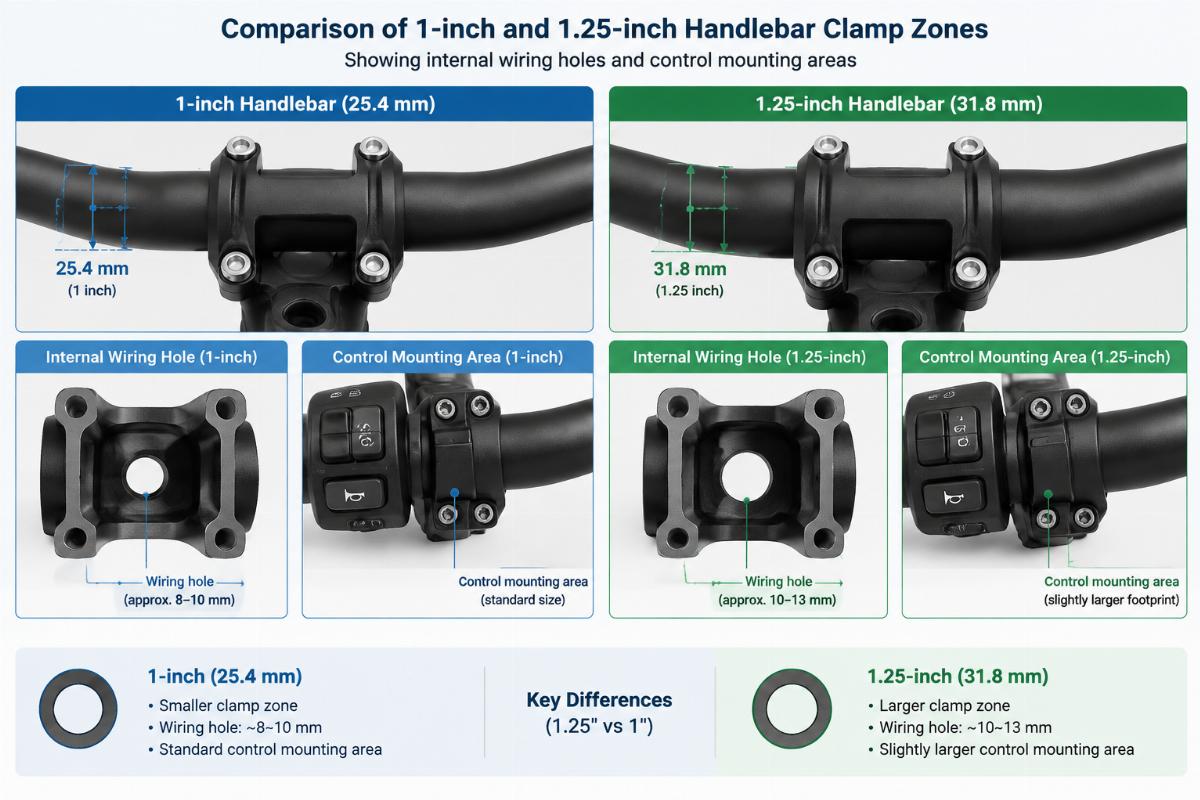
Understanding these hidden dimensions is critical for any distributor or builder sourcing from a 1-inch vs 1.25-inch handlebars wholesale supplier. It prevents the mismatch that turns a profitable order into a logistics nightmare.
What Is the Real Difference Between 1-Inch and 1.25-Inch Bars?
The primary difference lies in structural rigidity and control interface requirements, not just visual bulk.
Many buyers assume that switching from 1-inch to 1.25-inch is a simple style upgrade. In reality, it changes the physics of the front end. A 1.25-inch bar offers significantly higher torsional stiffness, which reduces vibration feedback to the rider’s hands on large-displacement V-twins. However, this increased thickness means standard 1-inch controls will not fit without modification or replacement.
| Feature | 1-Inch Handlebars | 1.25-Inch Handlebars |
|---|---|---|
| Control Compatibility | Fits standard OEM-style switches directly | Requires specific 1.25-inch controls or adapter shims |
| Structural Rigidity | Standard flexibility, may transmit more vibration | High rigidity, reduces hand fatigue on long rides |
| Clamp Zone Design | Typically round or minimal flat section | Often features a wider flat section for secure clamping |
| Internal Wiring Space | Limited, may restrict thick aftermarket harnesses | Generally larger, but varies by manufacturer quality |
| Typical Application | Stock replacements, classic styles, Sportster models | Custom choppers, baggers, high-vibration Big Twins |
The table above highlights why you cannot simply swap diameters. The clamp zone design is particularly critical. On a 1-inch bar, the area where the controls mount is often round, relying on the friction of the clamp band. On many 1.25-inch bars, manufacturers machine a flat section to prevent the controls from rotating under torque. If you install standard round-clamp controls on a flat-zone 1.25-inch bar, they will not seat correctly, leading to slippage and potential throttle sticking. [NEED_CITE: motorcycle handlebar clamp standards and safety implications]
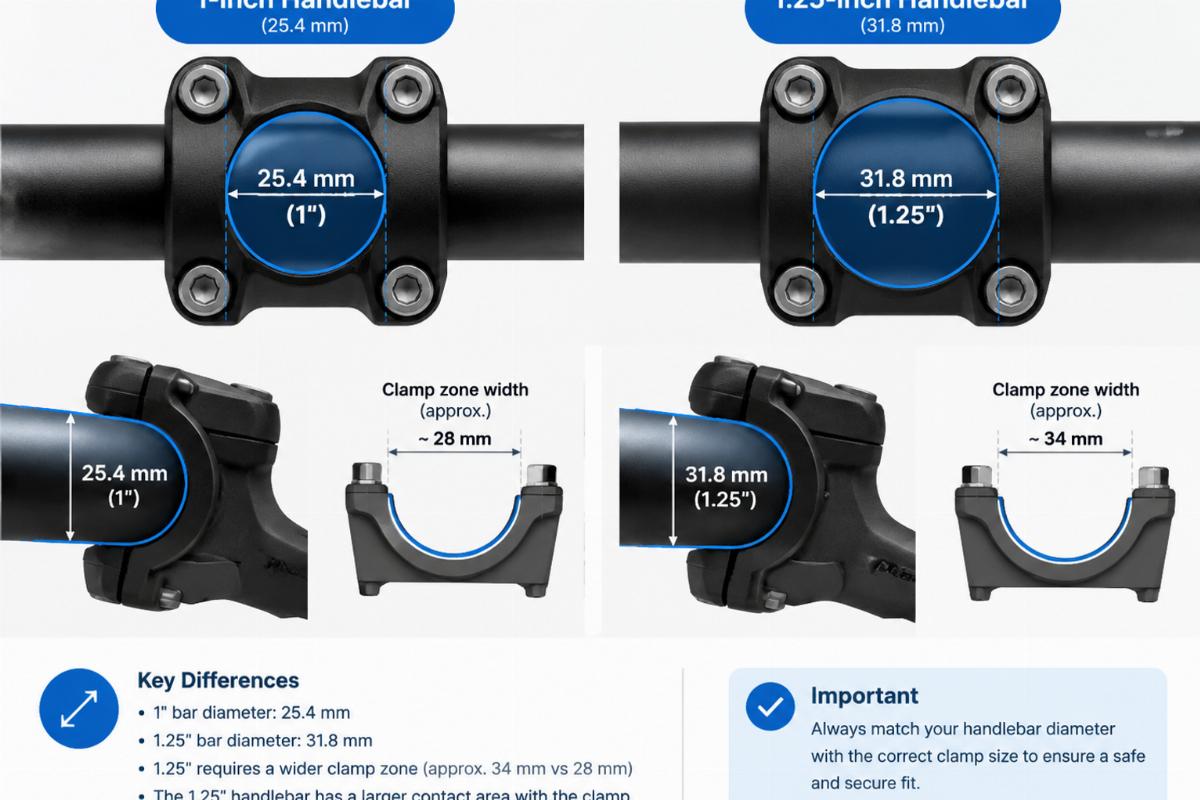
When sourcing from a 1-inch vs 1.25-inch handlebars wholesale supplier, always request the specific dimensions of the clamp area. Do not rely on the general diameter label alone.
How Does Diameter Affect Internal Wiring and Control Installation?
Larger diameters do not automatically guarantee easier wiring; internal hole quality varies significantly.
A common misconception is that all 1.25-inch bars have large, clear internal passages. In my experience, some budget-friendly 1.25-inch bars have smaller internal holes than premium 1-inch bars. This happens when manufacturers use thicker wall tubing to achieve the outer diameter without increasing the overall weight or cost. The result is a narrow internal bore that blocks modern, thick-insulated wiring harnesses.
For Harley-Davidson Evo and Twin Cam models, the factory harness is relatively compact. However, custom builders often add auxiliary lights, USB chargers, or upgraded audio systems, which require thicker wires. If the internal hole is too small, the installer must force the harness through, risking insulation damage and short circuits. In one case, a European distributor reported that nearly half of their 1.25-inch bar orders were returned due to wiring clearance issues. The bars looked robust, but the internal diameter was insufficient for the aftermarket harnesses their customers preferred.
Control installation is equally tricky. 1-inch controls are ubiquitous and inexpensive. 1.25-inch controls are less common and often more expensive. If a buyer orders 1.25-inch bars but keeps their old 1-inch controls, they face a fitment failure. Some suppliers offer shims to adapt 1-inch controls to 1.25-inch bars, but these can compromise the security of the clamp if not machined precisely. [NEED_CITE: impact of handlebar shim usage on control stability]
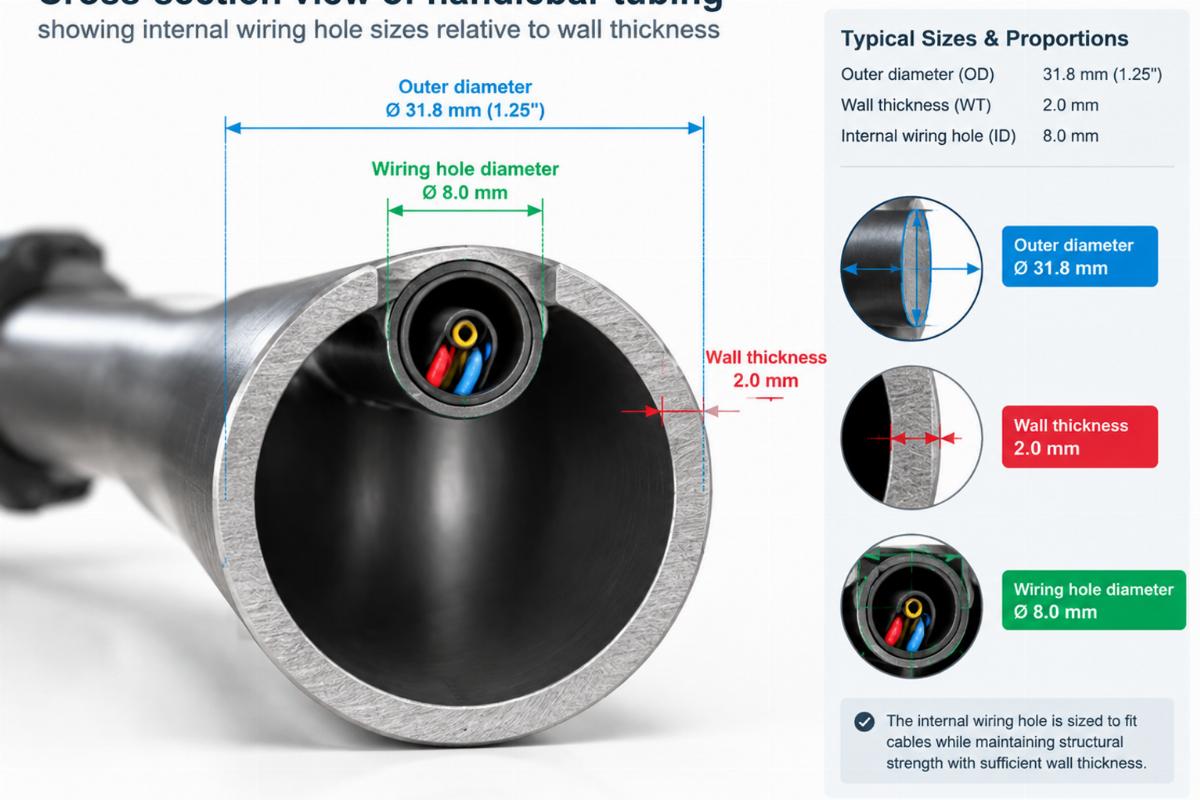
To avoid this, verify the internal wiring hole diameter against your target harness thickness. Ask your 1-inch vs 1.25-inch handlebars wholesale supplier for this specific measurement, not just the outer diameter.
Which Handlebar Size Fits Your Harley-Davidson or Yamaha XS650?
Fitment depends on the model year, triple tree spacing, and original equipment specifications, not just rider preference.
Harley-Davidson has used both 1-inch and 1.25-inch bars across different eras and models. Early Shovelheads and many Sportsters typically use 1-inch bars. Later Softails and Touring models often feature 1.25-inch bars at the clamp, tapering to 1-inch at the grips, or remaining 1.25-inch throughout. The Yamaha XS650, a popular platform for custom builds, originally came with 7/8-inch or 1-inch bars, but many customizers upgrade to 1.25-inch for a more aggressive stance.
However, upgrading to 1.25-inch on an XS650 or an older Harley requires checking the triple tree clamp width. If the clamps are designed for 1-inch bars, they will not close properly around a 1.25-inch bar. This may require replacing the triple trees or using adapter plates, which adds complexity and cost. For Harley-Davidson Big Twins from 1984 onwards, the transition to 1.25-inch became more common, but variations exist. Always consult the factory service manual for the specific model year to determine the original bar diameter and clamp specifications. [NEED_CITE: Harley-Davidson factory service manual handlebar specifications]
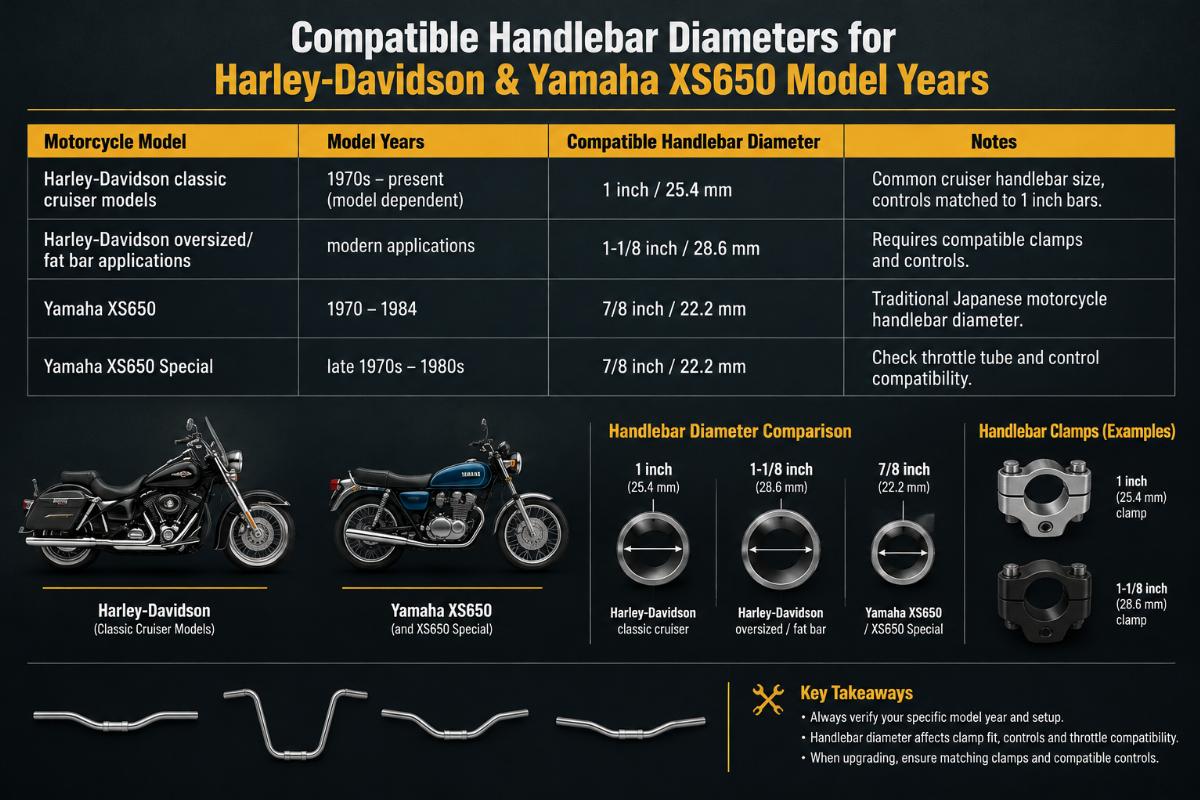
When working with a 1-inch vs 1.25-inch handlebars wholesale supplier, provide the exact model and year of the motorcycles you are targeting. This allows for precise cross-referencing against OEM specifications.
Common Fitment Mistakes and How to Avoid Them
Verifying clamp area dimensions and internal hole size prevents the majority of fitment errors.
The most frequent mistake is assuming that “1.25-inch” is a universal standard. It is not. The width of the flat section in the clamp zone varies between manufacturers. Some are wide, some are narrow, and some are non-existent. If the control clamp does not match the bar’s flat section, the controls will rotate or slip. Another common error is ignoring the internal wiring hole size, leading to harness damage during installation.
To avoid these issues, follow a strict verification process:
- Measure the outer diameter at the clamp zone, not just the grip area.
- Check the internal wiring hole diameter against your thickest expected harness.
- Verify the width and shape of the control clamp area matches your intended switches.
- Confirm the bar rise and pullback do not interfere with the fuel tank or fairing.
In our operations, we include exact clamp zone dimensions and internal hole specs in our fitment sheets for each bar model. This allows buyers to verify compatibility before ordering samples. A US buyer once avoided a major return by requesting these details upfront. He discovered that the 1.25-inch bars he selected had a narrow flat section incompatible with his wide-body controls. He switched to a different model with a wider clamp zone, saving his project from delay.
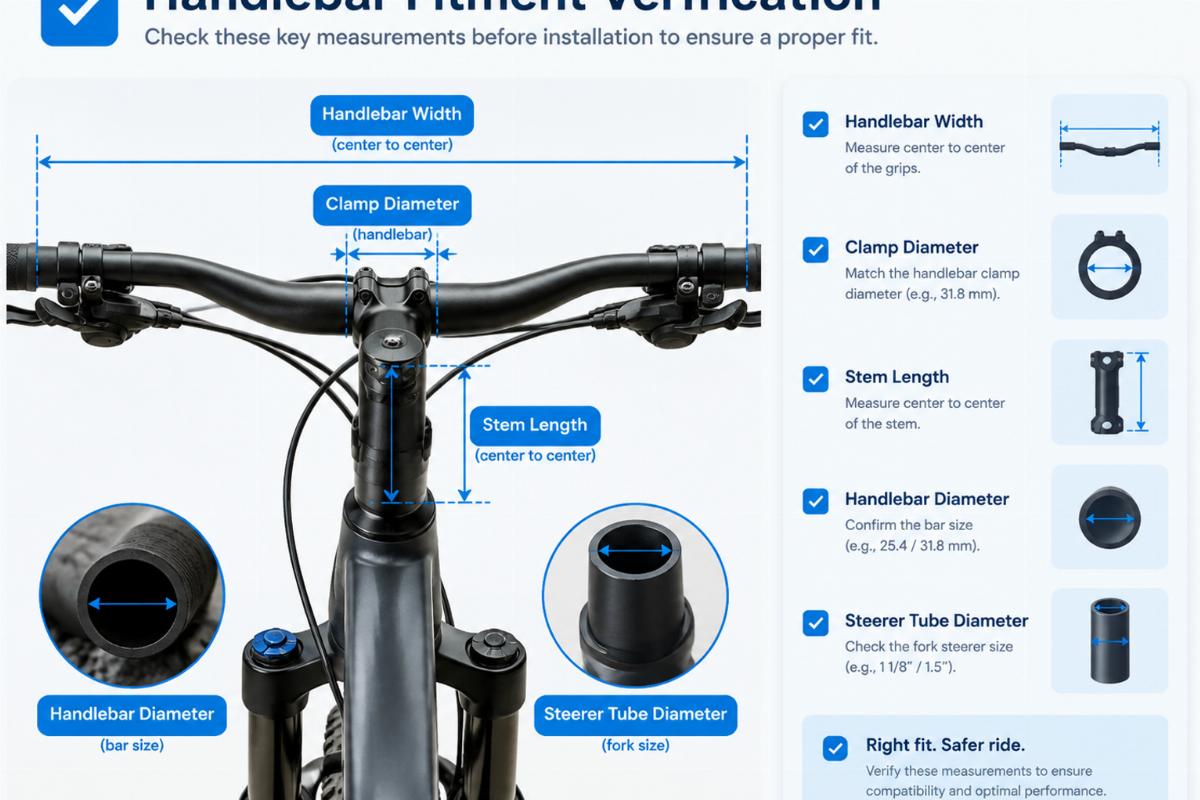
By treating diameter as a multi-dimensional specification, you ensure that every bar from your 1-inch vs 1.25-inch handlebars wholesale supplier fits perfectly the first time.
Conclusion
Correct handlebar selection requires detailed dimensional verification, not just diameter matching.
Choosing between 1-inch and 1.25-inch handlebars involves assessing control compatibility, internal wiring capacity, and clamp zone geometry. Misidentifying these factors leads to incompatible controls and failed installations. By focusing on precise measurements and verifying fitment against specific model requirements, distributors and builders can reduce returns and ensure successful builds. Always prioritize technical clarity over aesthetic assumptions when sourcing from a 1-inch vs 1.25-inch handlebars wholesale supplier.