
Wholesale Detachable vs Fixed Sissy Bars Pros and Cons
Freight costs often outweigh the machining premium.
The choice between detachable and fixed sissy bars is determined by container volume efficiency and mechanical tolerance precision, not merely aesthetic preference. Importers must prioritize locking pin specifications to prevent joint rattling while optimizing landed costs through reduced shipping footprints.
I still remember the silence in the warehouse after we unloaded that first container of fixed uprights for a custom shop in Los Angeles. The parts were solid, welded with care, and finished in a deep chrome that caught the light perfectly. But as we stacked them on the pallet, I realized the one-piece bases were eating up space at an alarming rate. We were paying ocean freight for air and steel geometry that could have been nested. The shop owner later told me his mechanics hated wrestling the entire assembly off just to wash the bike or access the rear fender struts. That logistical friction, combined with the inflated shipping bill, nearly wiped out the margin on the whole order. It was a hard lesson in how physical design dictates financial reality in the aftermarket parts trade. [NEED_CITE: impact of packaging density on ocean freight landed cost]
This experience shifted my focus from simple part substitution to systemic logistics analysis. When buyers ask about the detachable vs fixed sissy bars debate, I no longer start with looks. I start with their container loading plans and the maintenance habits of their end users. The decision is less about style and more about balancing freight efficiency against the risk of mechanical failure at the joint.
How Do Freight Costs Influence Sissy Bar Design Choices?
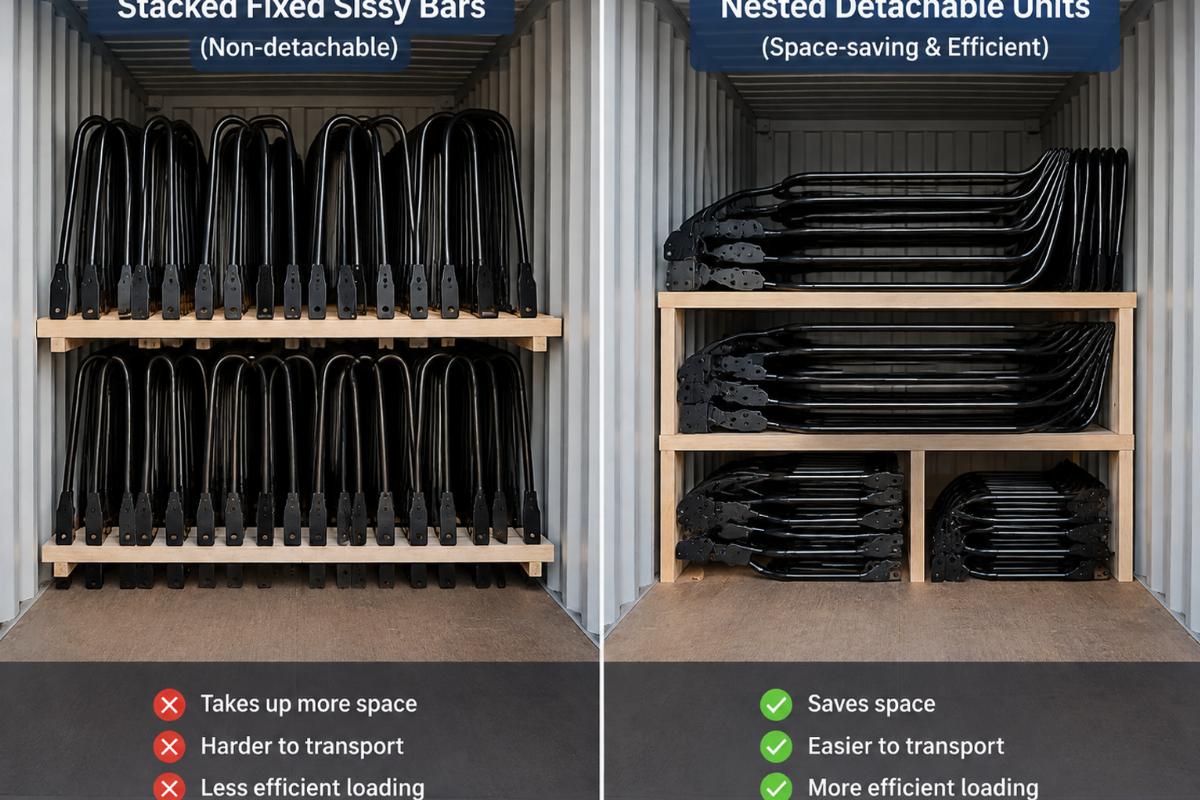
Detachable units solve critical ocean freight volume issues by allowing components to be nested.
The primary advantage of detachable designs lies in their ability to break down into smaller, stackable elements. A fixed sissy bar consists of a base plate permanently welded to an upright, creating a rigid but bulky shape that resists efficient packing. In contrast, a detachable system separates the base from the upright, often allowing multiple bases to lie flat and uprights to bundle together. This reduction in volumetric weight can significantly improve container utilization rates. [NEED_CITE: standard container loading efficiency metrics for motorcycle accessories]
For a distributor importing hundreds of units, this spatial efficiency translates directly to lower per-unit landed costs. Even if the machining cost for a detachable locking mechanism is higher than a simple weld, the savings in freight can offset that premium. I have seen cases where switching to detachable units allowed a buyer to fit substantially more inventory into a single 40-foot container, effectively reducing the shipping cost per piece by a noticeable margin. This is why many wholesale suppliers now default to detachable designs for bulk orders, unless the customer specifically requests fixed units for niche applications.
| Feature | Fixed Sissy Bar | Detachable Sissy Bar |
|---|---|---|
| Packaging Volume | High (rigid geometry) | Low (nestable components) |
| Freight Efficiency | Vulnerable to high volumetric weight | Robust optimization of container space |
| Assembly Requirement | None (ready to install) | Required (pin insertion and tightening) |
| Primary Cost Driver | Material and welding labor | Machining precision and hardware |
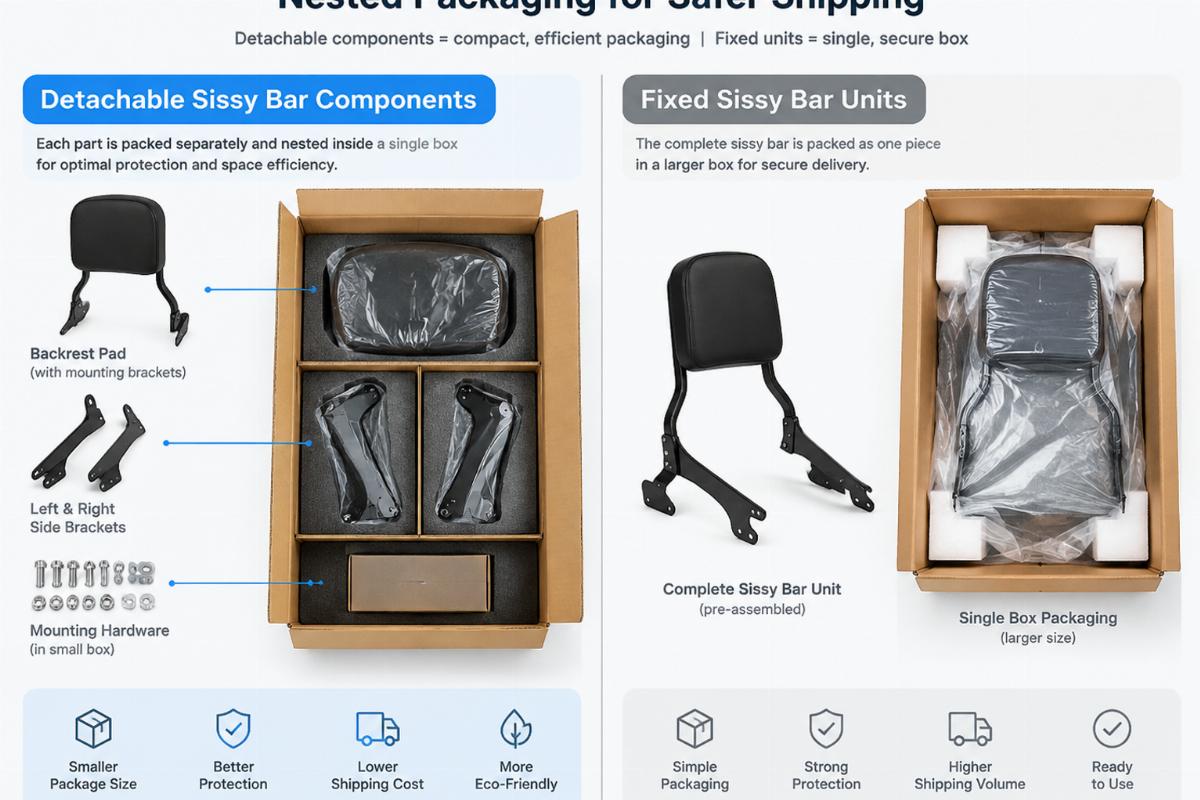
However, this logistical benefit comes with a caveat. The detachable interface introduces a potential point of failure. If the locking mechanism is not machined to tight tolerances, the convenience of easy removal becomes a liability. Buyers must weigh the freight savings against the need for precise engineering. When evaluating detachable vs fixed sissy bars, consider whether your supply chain can absorb the risk of returns due to loose fittings, or if the freight savings provide enough buffer to invest in higher-quality locking pins.
What Are the Mechanical Risks of Detachable Joints?
Loose tolerances on locking pins lead to rattling and eventual structural fatigue.
The most common complaint regarding detachable sissy bars is noise. A slight gap between the pin and the receiver hole allows the upright to shift under vibration, creating a rattle that drivers find intolerable. This issue is not inherent to the concept of detachability but rather a result of poor manufacturing control. In one instance, a batch of bars we sourced had locking pins that were slightly undersized relative to the receiver holes. The discrepancy was minimal, barely visible to the naked eye, but after a few hundred miles of road vibration, the joints began to loosen. The shop owner called back furious, reporting that the bars felt unsafe after hitting minor potholes. [NEED_CITE: mechanical vibration effects on loose-fit motorcycle accessories]
To mitigate this risk, the diameter and tolerance of the locking pin must be strictly controlled. High-quality detachable systems use hardened steel pins with a snug fit that requires a deliberate action to insert and remove. Some designs incorporate spring-loaded detents or threaded collars to secure the pin in place, preventing it from working loose over time. These features add complexity and cost but are essential for maintaining rigidity. Without them, the detachable joint becomes a weak link in the chassis support system.
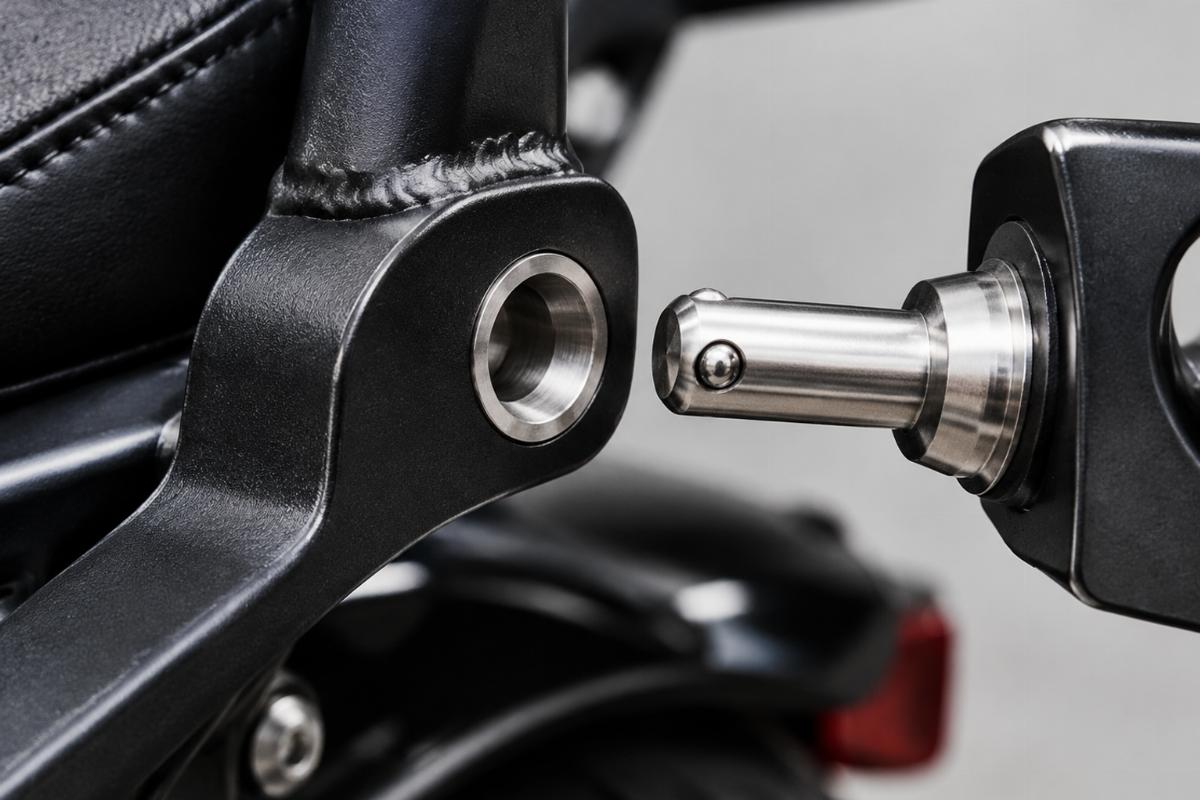
When sourcing these parts, inspect the finish of the pin and the interior of the receiver. Rough machining marks or inconsistent diameters are red flags. A well-made detachable bar should feel solid when assembled, with no perceptible play between the upright and the base. If you are comparing detachable vs fixed sissy bars, remember that a fixed bar eliminates this variable entirely by using a permanent weld. However, a poorly welded fixed base can also fail, often causing stress cracks in the frame mounting points. The key is not to assume one design is inherently superior, but to verify the quality control standards of the manufacturer. Precision machining is non-negotiable for detachable units.
Which Model Years Require Specific Fitment Checks?
Mounting points differ significantly between pre-1984 and post-1984 Big Twins.
Fitment is the most frequent source of returns in the aftermarket sissy bar business. Harley-Davidson changed its rear frame geometry multiple times over the decades, meaning a bar that fits a 1970 Shovelhead will not necessarily fit a 1990 Softail. The most critical divide is between pre-1984 and post-1984 models. Pre-1984 Big Twins often use different bolt patterns and strut angles compared to the Evolution and Twin Cam eras. Additionally, within the post-1984 range, distinctions exist between Softail, Dyna, and Sportster families. [NEED_CITE: OEM service manual mounting point dimensions for Harley-Davidson models]
For example, the Softail line mimics the look of a hardtail frame but uses hidden rear shocks. This design affects where the sissy bar base can mount, often requiring specific brackets that clear the shock absorbers. Dyna models, with their exposed twin shocks, offer different mounting opportunities but may interfere with certain upright styles. Yamaha XS650 builds, another popular platform for customizers, have their own unique frame dimensions that do not align with Harley patterns. Assuming universal fitment is a costly mistake.
| Model Family | Era | Mounting Consideration |
|---|---|---|
| Big Twin Pre-1984 | Knucklehead/Panhead/Shovelhead | Unique bolt patterns, often requires custom adapters |
| Big Twin Post-1984 | Evolution/Twin Cam | Standardized but varies by Softail/Dyna sub-model |
| Sportster | All Years | Compact frame, limited mounting space |
| Yamaha XS650 | Custom Builds | Non-Harley pattern, requires specific fitment verification |
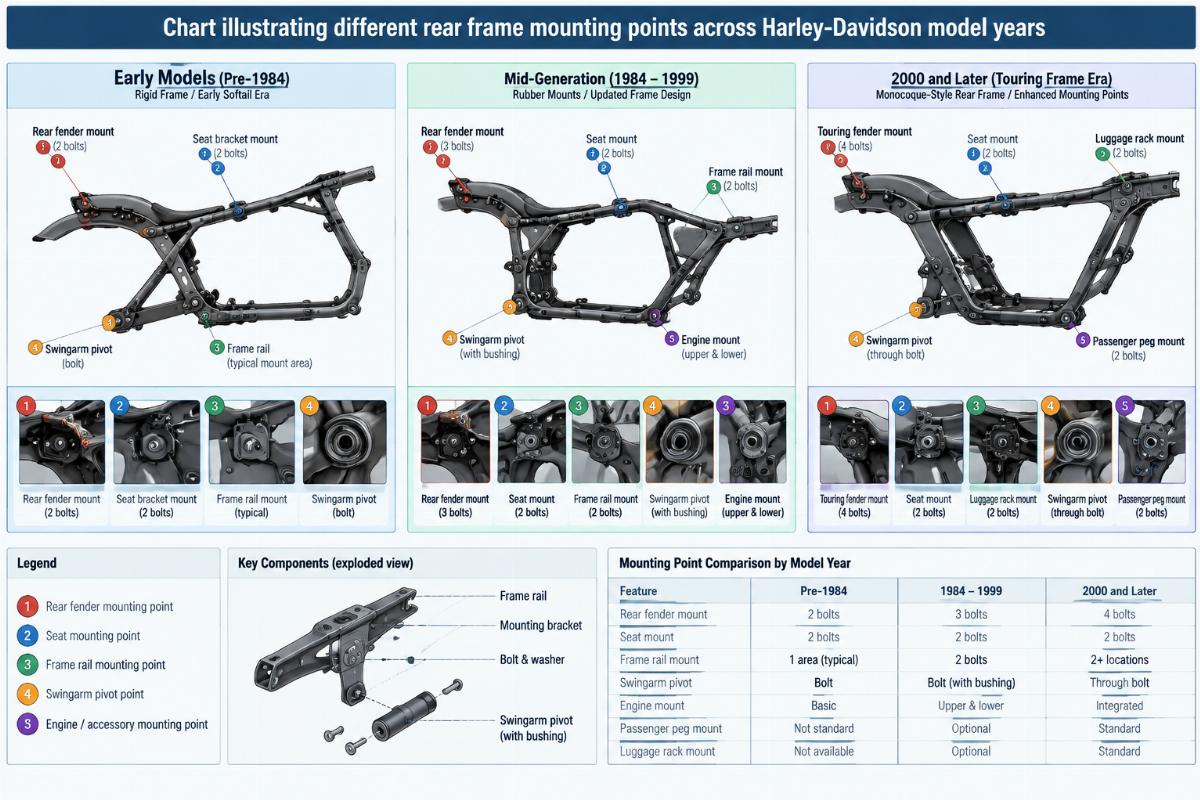
We cross-reference every order against OEM numbers and model year ranges to prevent mismatches. Providing a detailed fitment sheet with the shipment helps dealers avoid installing the wrong part. When discussing detachable vs fixed sissy bars, ensure that the base plate design matches the specific strut spacing of the target motorcycle. A detachable base that does not align correctly will not only look wrong but may also compromise safety. Always verify the year range before finalizing a purchase.
When Should You Choose Fixed Over Detachable?
Fixed bars suit static displays or riders who never remove the seat, offering simpler installation.
Despite the logistical advantages of detachable units, there are valid reasons to choose fixed sissy bars. For show-bike builders and restorers who prioritize absolute rigidity and a seamless aesthetic, a fixed bar eliminates the visual interruption of a locking pin. The continuous line from the base to the upright can enhance the clean look of a chopper or bobber. Additionally, for riders who never remove their seats for maintenance or washing, the convenience of detachability is irrelevant. In these cases, the simplicity of a fixed installation is preferable. [NEED_CITE: user behavior trends in motorcycle customization and maintenance]
Fixed bars also reduce the number of small parts that can be lost or damaged. There is no pin to misplace, no receiver to clog with dirt, and no mechanism to fail. This makes them a reliable choice for daily riders who want a set-and-forget solution. However, the trade-off is the difficulty of removal. If a rider needs to access the rear wheel or clean the fender extensively, removing a fixed bar may require unbolting the entire assembly, which can be cumbersome.
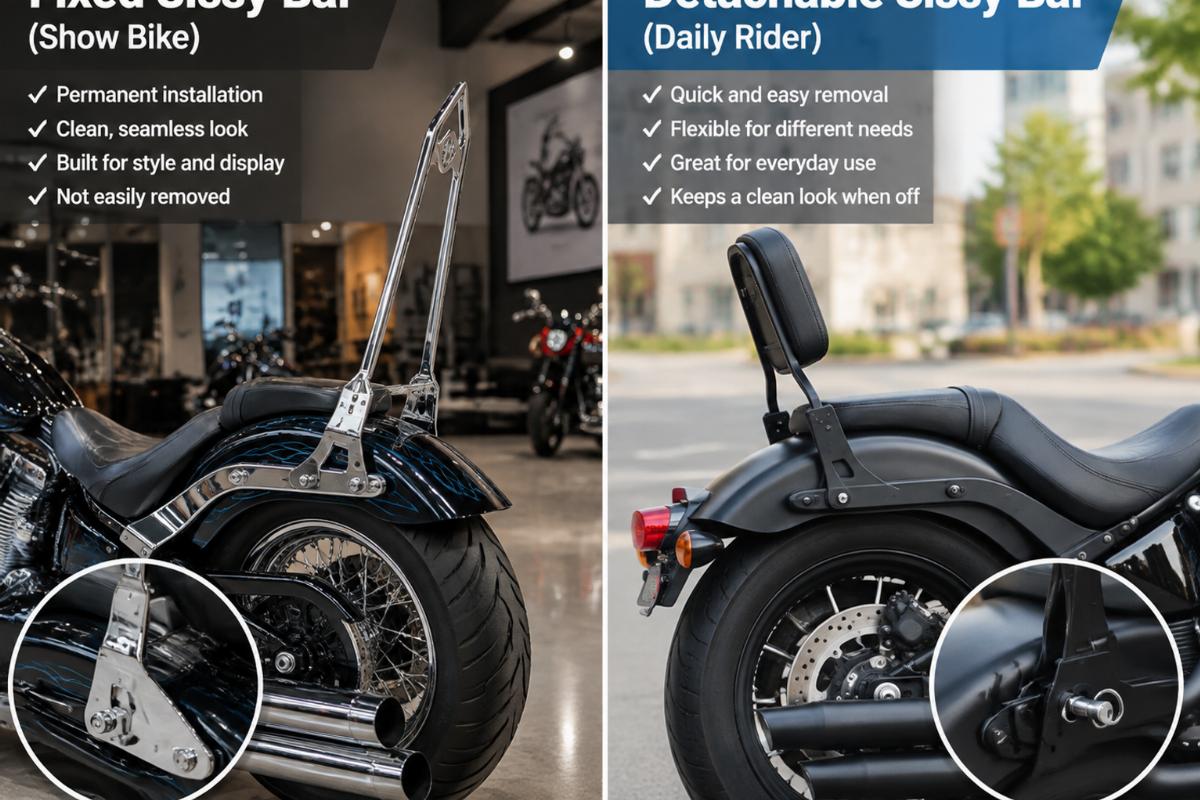
Ultimately, the decision depends on the end user’s lifestyle. If your customers are enthusiasts who frequently detail their bikes or swap seats, detachable units are the practical choice. If they are building static show pieces or prefer minimal maintenance interaction, fixed bars may be more appropriate. Understanding this distinction helps you stock the right mix of detachable vs fixed sissy bars for your market. Do not assume one size fits all; analyze your customer base’s behavior to determine the optimal product ratio.
Conclusion
Logistics and tolerance define the value proposition, not just aesthetics.
The debate over detachable vs fixed sissy bars resolves when you align the product with your supply chain constraints and customer needs. Detachable units offer superior freight efficiency and user convenience but demand precise machining to avoid rattling. Fixed bars provide simplicity and rigidity but incur higher shipping costs and less flexibility. Verify fitment against specific model years and prioritize quality control on locking mechanisms to minimize returns. Send your model and year for a fitment check to ensure compatibility before ordering.